Thesis: choose the cut and backing to show the stripes, not hide them
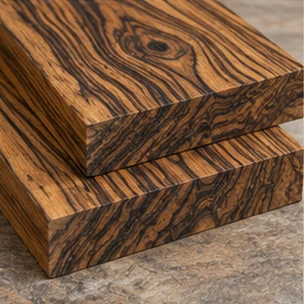
Macassar Ebony is chosen for accents because of its strong, contrasting striping. For small-scale accents — inlay bands, instrument bindings, narrow beading and thin-faced panels — the veneer cut and the backing or lamination strategy determine whether those stripes read crisply or become muddied. This guide focuses on practical decisions you must make in the shop: when to ask for sliced veneer, when rotary is acceptable, what backing will survive routing and bending, and how to finish very thin faces without telegraphing substrate or losing striping contrast. For full-wood options and lumber-grade considerations, see the Macassar Ebony lumber product page (macassar-ebony-lumber).
Sliced vs rotary: pick the cut to control stripe direction and consistency
Sliced veneer (flat-sliced, quarter-sliced, crown/half-cut variants) is the default choice when you want clearly defined zebra-like stripes. Slicing follows a board-like motion: the knife removes sheets that preserve the log’s growth-line contrast and give repeatable leaves you can bookmatch. For narrow banding and thin faces where the stripe orientation matters, specify sliced veneer and indicate whether you want rift/quarter or flat-cut appearance.
paragraphs? null],
When rotary makes sense — and when it doesn’t
Rotary-cut veneer is produced by peeling the log on a lathe; it yields wide, broad, less-precise banding and more color variation. That can be useful on large panels where dramatic, continuous figure is acceptable or desirable, but it is usually the wrong choice for fine inlay, small accent strips or cases where you need repeatable bookmatching. Rotary faces also tend to be thinner and more wasteful of a precious log when you need several matching leaves.
Backing and lamination options: match use and manipulation
Backings are as important as the face when you are making small parts or thin-faced panels. Common approaches are:
- Raw (unbacked) veneer: supplied as thin wood sheets for veneer layup. Best when you will crossband and press a balanced panel in the shop. Requires a press (flat or vacuum), careful adhesive selection and a backer veneer to counteract movement. Use raw faces when you want to control the entire layup and glue schedule.
- Paper-backed veneer: a thin face with a paper backer makes handling and cutting small strips and inlays much easier. Paper backing stabilizes very thin faces during routing and banding and is common for knife-edge banding and marquetry. The paper is usually removed or remains as part of a plywood/laminate depending on the supplier’s spec.
- Composite/phenolic-backed veneer or laminated face: when you need a thin, dimensionally stable face that will be post-formed, bent or put onto a non-wood substrate, ask for a more robust backing. These faces are frequently specified for commercial casework and thin tabletops because they glue and machine more predictably and reduce the chance of telegraphing.
Practical note: whatever you choose, plan a balanced construction. If a thin Macassar face is glued to a plain MDF or plywood core without a back veneer or balanced backing, the panel can cup or reveal glue-line stress. For small solid-wood subcomponents, use a backer veneer to mirror the face.
Bookmatching and layout tips for stripe control
If the stripe pattern is the design element, talk to your supplier about flitch selection and sequence. Adjacent leaves from a sliced flitch will bookmatch predictably; order them in the sequence you want laid out. For vertical stripe accents, consider center- or slip-matching to keep strong lines continuous across a join.
paragraphs? null],
Cutting, routing and gluing thin faces — shop strategies
Thin Macassar faces can tear or chip during cutting and routing. Use sharp carbide tooling and high feed with low depth-of-cut to reduce tearout. When trimming inlay strips, clamp with sacrificial cauls and score the cutline where the veneer will meet more fragile substrate edges.
paragraphs? null],
Finishing thin veneers without deadening the stripe
Two practical issues show up after veneering: telegraphing (the substrate or glue line showing through) and loss of contrast from heavy surface coatings.
paragraphs? null],
Finish workflow (practical sequence)
1) Test a finish and adhesive on a scrap assembly that exactly matches your face thickness and substrate. Macassar Ebony can have natural oils and tannins that affect adhesion; testing confirms adhesion and color change.
2) Seal edges and any open endgrain before final bonding; thin faces telegraph glue squeeze badly, so a light barrier coat on the face (thin wipe of shellac or similar reversible sealer) reduces this risk when you’ll sand and rub out later.
3) Use thin, buildable finishes in many light coats rather than a few heavy coats to preserve stripe contrast. Avoid heavy pigmented sealers that will darken the figure. For very thin faces, a clear, thin barrier coat followed by multiple thin topcoats yields the most consistent result.
4) If you must hide a glue line, use a color-matched epoxy filler sparingly and sand carefully. Don’t over-sand the face veneer; it’s easy to go through thin faces.
Ordering and specification checklist — what to ask your supplier
- Specify sliced veneer for controlled stripe direction; only accept rotary if you want broad, peeled figure.
- Ask for flitch photos and the exact leaf sequence for bookmatching.
- State the backing: raw, paper-backed, or composite/phenolic-backed and whether you’ll receive full-size sheets, strips or pre-cut banding.
- Confirm face thickness and whether the veneer is sanded or finished at the mill.
- Specify edge conditions (square or backed) if you need pre-banded profiles or routed inlays.
- Request handling guidance from the supplier for the lot you receive and build a test panel to verify adhesive and finish compatibility before you commit veneer to finished work.
Finally, for full lumber options and matching stock for thicker accents, cross-compare the veneer choices with the Macassar Ebony lumber listing (macassar-ebony-lumber).
BEFORE YOU REQUESTYour sourcing checklist.
- Specify cut: sliced (preferred for stripes) or rotary (for broad, peeled figure)
- Provide layout: bookmatch or slip/center match and request flitch photos
- Choose backing: raw (for layup), paper-backed (for handling and inlays), or composite-backed (for bending/postforming)
- Confirm face thickness and whether veneer is sanded or sealed at the mill
- Request leaf sequence and length to match bookmatching requirements
- Order a test panel to verify glue and finish compatibility with your chosen backing and substrate
- Plan balanced layup: always include a back veneer or balanced construction to minimize cupping
- Confirm supplier handling guidance and any special shipping/packing for thin exotic faces
Common questions.
Should I use sliced or rotary Macassar Ebony veneer for accents?+
Use sliced veneer when you want crisp, repeatable stripes and the ability to bookmatch; it preserves the board-like look and gives you leaves you can sequence. Use rotary only when you want broad, continuous, peeled figure across large panels and you don’t need tight bookmatching.
Which backing should I choose for thin inlay strips?+
For hand-cut inlay and small strips, paper-backed veneer is easiest to handle and routes with less tearout. If you are pressing your own balanced panels, raw (unbacked) faces give the most control. For bending or commercial casework where dimensional stability matters, ask for a composite/firm backing.
How do I avoid telegraphing and glue lines through thin Macassar faces?+
Build a balanced assembly (face + backer), use a thin barrier coat on the face when appropriate, use even pressure during pressing, and test adhesives. If a glue line remains visible, a judicious color-matched epoxy filler and minimal sanding will hide it without thinning the face veneer.
Can I bend Macassar Ebony veneers?+
Bending very thin veneers is possible but depends on the backing and adhesive system. Paper-backed and phenolic-backed faces bend more predictably than raw thin faces; always test on a mock-up to confirm springback and finish behavior.
Any special finishing notes for Macassar Ebony faces?+
Test for oiliness and color shift first. Use thin, buildable topcoats and avoid heavy pigmented sealers that flatten contrasts. Multiple thin layers applied after a light, reversible seal reduce the chance of darkening the stripe pattern. Always test on a sample matched to your face thickness and substrate.