Short answer and design tradeoffs
Yes — Sapele is commonly used for interior flooring and stair treads, but it is not a drop-in replacement for every hardwood. Its attractive warm reddish-brown tones and strong ribbon figure make it a popular choice where appearance matters. At the same time Sapele's interlocked grain and working characteristics create specific machining and finishing demands that influence yield, installation method, and maintenance decisions.
This guide explains the practical tradeoffs you’ll face: how to pick grades and product forms for wear, what to require from the mill when you need flooring tolerances, how to finish for durability, and what routine maintenance keeps Sapele floors and treads performing.
Appearance, grain, and how that affects performance
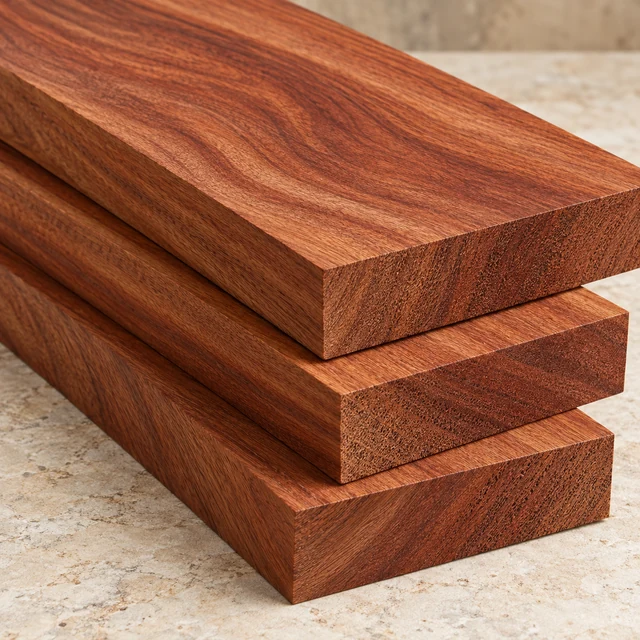
Sapele typically shows a golden-pink to reddish-brown heartwood with a pronounced ribbon figure on quartersawn faces and a chatoyant, interlocked grain on flatsawn boards. That interlocked grain is beautiful but it also makes the wood more prone to tear-out with dull cutters and aggressive jointer or planer settings.
Visually, expect color and figure variation from board to board and across a lot. For flooring and treads you should decide early whether you want a uniform look (select face-matched boards, tighter color selection) or a lively floor that celebrates the variation. That choice affects how much sorting and face-matching you require at the mill or during installation.
Grading and selecting material for wear
Specify a wear-appropriate grade. For floors and treads, choose boards with minimal large knots, gum or bark pockets, and sapwood. Selects or clear grades (or the equivalent in your supplier’s grading system) reduce the number of defects that concentrate wear and make finishing more difficult.
If you plan to use solid planks, ask for boards milled from stable flatsawn or quartersawn material depending on the look and movement tolerance you need: quartersawn boards will show straighter ribbon figure, tend to stay flatter across the face, and have slightly different movement characteristics than flatsawn. For commercial or high-traffic projects specify engineered planks with a Sapele wear layer — engineered construction is more stable, especially over slabs or with radiant heat.
Milling and fabrication to flooring tolerances
Tell your mill or shop what tolerances matter upfront. For tight seams and consistent stair nosings you want straight, square edges, consistent thickness, and faces run flat. Sapele’s interlocked grain benefits from very sharp tooling, reduced depth of cut, and lower feed rates on jointers and planers to avoid tear-out. Use shear-cutting knives where possible and test on a scrap piece from the same lot before batch milling.
When producing treads, many shops laminate boards edge-to-edge to reach required thickness and to minimize waste. Face-glued edge joints for treads should be machined and planed only after glue is fully cured and with sharp cutters. For nosings and bullnoses, machine allowance for final sanding and rounding; avoid heavy hogging cuts near the edge where tear-out is most likely. If you’re producing tongue-and-groove solid plank flooring, hold consistent tongue dimensions and inspect profiles for tight fit — poor profiling shows immediately on a floor.
Finishing for durability and color control
Finish choice is one of the biggest levers for durability. Hard film finishes — such as oil-modified polyurethanes, conversion varnishes, or UV-cured polyurethanes — give the best abrasion resistance for floors and treads. Apply multiple thin coats and follow the manufacturer’s recommendations for sanding between coats. Because Sapele can darken and deepen with oil-based finishes, test your full finish sequence on boards from the same lot to confirm final color.
If you prefer a hand-rubbed or oil finish for a softer hand, be realistic about wear: oils need more frequent maintenance and reapplication in high-traffic areas and on stair nosings. For stairs consider a tougher film finish on the tread surface and a matching hand-applied finish on risers and stringers for appearance continuity.
Stair-specific construction and installation notes
Stair treads concentrate impact and scuffing; design and detail accordingly. Use thicker laminated treads rather than a single thin board where possible, and consider a glued lamination with the grain orientation chosen to minimize cupping. For nosings, machine an oversized profile and final-shape after the tread is fully acclimated and sanded to avoid mismatched profiles and gaps.
Attachment and substructure matter as much as the wood: support under the tread should prevent bounce and hold fasteners away from thin end grain where splitting is likely. Pre-seal the underside of treads and nosings if the staircase sits over a conditioned/unconditioned boundary, and follow a careful acclimation and adhesive selection process when installing over concrete or with radiant heat (engineered construction is usually the safer choice in those conditions).
Maintenance expectations and lifecycle tips
Routine maintenance for Sapele flooring follows the usual regime for hardwood: keep grit off the surface, use protective pads and mats in entryways, and clean with a manufacturer‑approved product for your finish. With a hard film finish, spot-repair and recoat small areas as part of scheduled maintenance rather than sanding the whole floor early.
Expect that high-traffic commercial installations will require more frequent recoating and earlier replacement of sacrificial elements like entrance mats and runners. Document the finish system and keep samples from the original lot so future repairs can match color and sheen. If you need long-term heavy-use performance, specify engineered Sapele with a robust wear-layer system and a commercial-grade finish.
BEFORE YOU REQUESTYour sourcing checklist.
- Specify the product form: solid plank, laminated tread blanks, or engineered planks with a Sapele wear layer.
- Require a grade suitable for wear — minimal large knots, sapwood, and defects; request selects/clear equivalent.
- Ask about milling tolerances: flatness, thickness consistency, edge squareness, and tongue‑and‑groove profiles if applicable.
- Request a machining sample from the same lot to check for tear‑out, finish color, and final sheen.
- Decide on finish system up front and require finish testing on lot material; document the agreed finish and maintenance plan.
- If using solid planks, confirm acclimation, subfloor conditions, and whether engineered construction is recommended for the jobsite (concrete or radiant heat).
- Order a modest overrun to allow for sorting, face‑matching, and replacement of cutoffs during installation.
Common questions.
Is engineered Sapele a better choice than solid for stairs and floors?+
Engineered construction is often the safer choice for stability — especially over concrete slabs, in multi‑family or commercial settings, or where radiant heat is present. Engineered planks keep the Sapele face for appearance while reducing movement, but solid planks are fine in stable, suitable subfloor conditions with correct acclimation.
Will Sapele show wear quickly compared with other hardwoods?+
Sapele has good wear characteristics when properly finished, but like all exotics it benefits from a robust film finish and preventive maintenance. High-traffic areas and stair nosings will show wear sooner than low-traffic rooms; plan for periodic recoats rather than early sanding where possible.
Any machining tips to avoid tear-out?+
Yes. Use very sharp cutters, reduced depth of cut, higher cutter speed or shear blades, and consider a climb cut on tricky edges. Test setups on the same lot before milling production quantities.
How should I specify Sapele to a supplier?+
Specify product form (solid, laminated treads, engineered), grade for wear, preferred face orientation (flatsawn vs quartersawn), required milling tolerances, and request a sample finish applied to material from the lot. Include installation conditions (concrete slab, radiant heat) so the supplier can recommend engineered vs solid.