Thesis: Why choose a Timborana slab for a reception desk or statement millwork
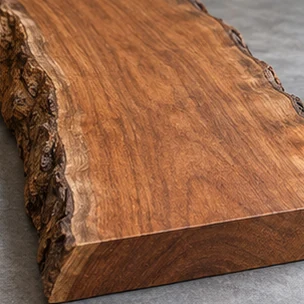
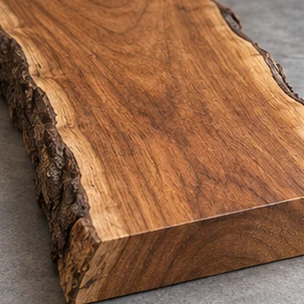
Timborana slabs are chosen for reception desks and statement millwork when you need a single, continuous face that shows large, bold figure, a dramatic color run, or a preserved live edge. The material brings immediate visual impact—minimal seams, a continuous grain flow, and surface area that reads as an architectural element rather than a collection of parts.
But dramatic appearance comes with tradeoffs: slabs are heavy, less forgiving to install, and they amplify issues (flatness, internal checks, bark inclusions). This guide shows which design decisions make the most sense for slab tops and when to prefer re-sawn faces or engineered builds that capture the look without the drawbacks.
1) Designing with whole slabs vs. re-sawn faces
Use a whole slab when the project goal is a single uninterrupted face—reception counters, long front desks, or vertical wall slabs where the grain and edge character are principal design drivers. Whole slabs preserve live edges and wide figure that re-sawn pieces can’t reproduce.
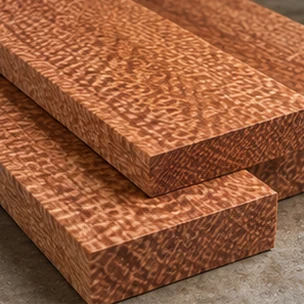
Choose re-sawn faces or bookmatched slabs when you need consistent thickness, easier handling, or when you must laminate a slab face to a stable substrate (plywood or MDF) for dimensional control. Re-sawn faces let you produce wide, stable panels by edge-gluing narrow strips or applying slab faces over cores—useful for long runs, built-ins, or millwork where weight and movement must be minimized.
Design note: if the aesthetic depends on the slab’s edge (live edge or spalting), commit to that detail early—edge character influences joinery, reveal lines, and mechanical fastening strategies.
2) Subframe and support integration
Slabs demand a support strategy tailored to weight, span, and expected traffic. A welded steel frame or substantial plywood subframe with multiple support points is the usual starting point. For long spans, plan continuous support under the slab’s neutral axis to avoid sag over time.
Allow the slab to move across the frame. Fasten the slab using slotted clips, screws into inserts, or countersunk bolts with washers that permit seasonal movement; avoid rigid, full-surface gluing that traps the slab to a substrate. If the slab will be placed on a plywood or solid core cabinet, use a small number of constrained fastenings at discrete points and provide clearance elsewhere.
When preserving a live edge, build the frame to follow the edge line or add a secondary hidden cleat to support protrusions. For desks with service openings (cable grommets, lockable drawers, pass-throughs), pre-plan cutouts in the slab and reinforce local areas with blocks or metal plates to prevent local failure.
3) Surface finishing and edge details
Start finishing decisions during slab selection. Timborana can have open pores and active color/tannin that will react to sealers. Ask the supplier for guidance on tannin bleed and recommended sealers, and run finish trials on a scrap when possible.
For high-use reception counters, choose finishes rated for heavy wear—conversion varnishes, catalyzed lacquer, or a high-build polyurethane are common in commercial settings. Topcoats must be compatible with the chosen sealer; when in doubt, test adhesion and color change.
Edge options: preserve a live edge for visual drama, but plan for user comfort—ease sharp points and consider a modest radius where people will rest their arms. If you want a crisp machined profile, re-saw the edge and plane the slab edge to the profile, then finish with the same system as the face. When you fill voids along live edges, use matching wood filler or colored epoxy; keep filler decisions flexible until the slab is in shop and you can evaluate contrast under your finish choice.
4) Coordination with other materials and details
Match slab thickness visually and functionally to adjacent materials. If the slab sits over millwork faces, set the top so the slab’s thickness plus reveal matches door and drawer face heights, or design a reveal that becomes intentional architecture.
Transition details matter: where slab meets stone, metal, or glass, specify seals, gaps, and hard stops. Metals can be used as reveals or protective edges where traffic is heavy—plan for differential thermal expansion and dissimilar-material fastening.
For integration with service elements (sinks, power modules, signage mounts), coordinate hole locations with fabricators before finalizing the slab layout: relocations after cutting are possible but costly if the slab’s figure or edge is compromised.
5) Procurement, acceptance, and lead time considerations
Specify what you must receive with the shipment: high-resolution photos of the selected slab, a note of kiln-dry status and target moisture content, a flatness or tolerance expectation, and any face-work or thickness plan. Ask the supplier to mark defect areas, fissures, or bark pockets you’ll need to address.
Lead time for slab selection and shipment can be longer than for milled boards because buyers often choose a specific individual slab. Allow time for slab inspection, crating, and potential re-selection. For projects that require matched pairs or bookmatched faces, order both slabs from the same lot and confirm sequencing.
Before contract, agree on acceptance criteria and responsibilities for shipping damage. For practical procurement details—how to compare slab offers, crate and shipping options, and shipping cards—see the product page’s “How to compare slab offers” table and the shipping cards on the Timborana Slabs product page to lock down expectations and delivery logistics.
BEFORE YOU REQUESTYour sourcing checklist.
- Photos and face selection: request photos of the exact slab to be shipped
- Kiln-dry status and target moisture content: confirm before ordering
- Flatness and thickness tolerance: set expectations for face-work
- Edge condition and whether live edge will be preserved
- Markings for defects, checks, or large knots
- Confirm whether slabs are sold and shipped as-is or will receive shop face-work
- Crating and shipping terms; inspect shipping cards for handling requirements
- Lead time and sequencing for matched slabs or bookmatched pairs
- Finish compatibility notes and recommended test panels from supplier
- Acceptance criteria and damage claim process
Common questions.
Can Timborana slabs span long reception counters without intermediate supports?+
That depends on span length, slab thickness, and expected loads. Long uninterrupted spans typically require engineered frames or multiple support points. Don’t rely on the slab alone for structural spanning—design a supporting subframe sized for the slab’s weight and the application.
How do I control seasonal movement of a Timborana slab top?+
Control movement by confirming the slab is properly dried for the installation environment, using mechanical fastenings that allow sliding, and avoiding full-surface gluing to cabinets. Provide clearance at end conditions and use fasteners (slots/cleats) that permit the wood to expand and contract.
Is a live edge practical in a high-traffic reception area?+
Yes, if you treat user-contact areas—ease sharp points, fill unstable voids, and apply a durable finish. Live edges are visual assets but require design choices to protect both the surface and building occupants.
Should I finish a slab before or after installation?+
Finish operations can be staged: perform primary sanding and sealing in the shop for control, and complete final topcoats after installation to touch up cutouts, end profiles, and on-site adjustments. Coordinate with the installer to avoid contaminating nearby work.