Thesis — pick interior work now, treat exterior and floors as conditional
Kabukalli lumber is already a solid candidate for interior furniture, casework and decorative millwork without additional lab testing — provided you specify lot-level acceptance for moisture, appearance and machining. Exterior decking, siding and solid hardwood flooring are conditional uses: they can be successful, but only after you confirm lot-specific durability, dimensional stability, and finish/fastener compatibility with testing or representative field trials.
This guide explains what you can reasonably accept as standard, which uses need extra verification, the minimal tests to request from a supplier or lab, and three sample workflows (interior furniture, exterior decking, and flooring) you can hand to an estimator or shop foreman.
Where kabukalli works straight away — interior furniture and millwork
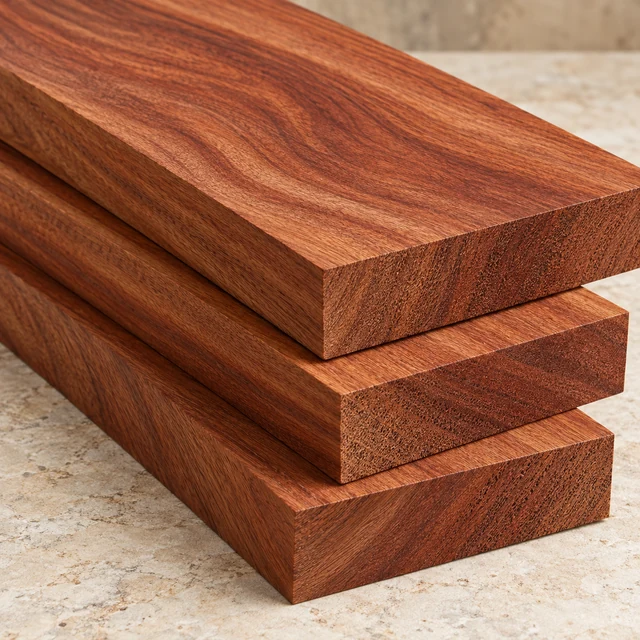
Use kabukalli for visible furniture faces, table and desk tops, cabinet doors, trim, moldings, shelving, mantels and interior stair treads when you: 1) receive kiln-dried material, 2) confirm a consistent appearance and acceptable sapwood/defect percentage for your design, and 3) accept standard shop processing steps (jointing, planing, glue-ups, and finishing).
Practical shop notes: acclimate boards to your shop environment until moisture meter readings are consistent between adjacent boards; mill predictable blanks from straight-grained flats to reduce cupping; set up cutters for a slightly slower feed if the lumber has interlocked or variable grain; and always seal end grain on slabs and live-edge pieces before final finishing to minimize uneven moisture loss and surface checking.
When to require tests — exterior decking, siding and solid flooring
Ask for verification before committing kabukalli to heavy exterior exposure (decks, stair treads exposed to weather, siding in unprotected exposure) or to high-traffic solid-plank flooring. The key questions are lot-level natural durability (resistance to fungal decay and termites in your climate), dimensional stability (how much movement and cupping you should expect in real service), and how the wood will behave with finishes and fasteners over time.
Minimum tests and verifications to request: an independent decay-resistance report or supplier durability statement for the lot; a representative sample subjected to an accelerated weathering or outdoor-exposure mock-up; and a wear/abrasion test if the material will be used as a finished flooring surface. Also confirm sapwood percentage in the shipment, because sapwood is usually less durable and more permeable than heartwood.
Practical tests and what they show
Decay-resistance or durability testing: tells you whether the heartwood resists fungal rot and insect attack for long-term exterior exposure. If the test shows marginal durability, plan to use kabukalli only in protected exterior locations (covered porches, soffit-clad areas) or as a capped, engineered product.
Weathering/mock-up and extractive-bleed trial: run a small exterior mock-up and a finish-sample board in the project climate to check for tannin/extractive bleed, color change, and surface checking. This will reveal finish adhesion problems and whether sealing all faces is sufficient.
Abrasion/wear testing and slip assessment: for flooring, require a wear test (or insist on engineered construction with a tested wear layer). For stair treads, include a wear trial and require installation details (fastener type, pre-drilling) to prevent long-term loosening.
Sample workflow — interior furniture or cabinetry (no extra lab testing)
1) Order specification: kiln-dried, grade and appearance sample, stated moisture content range at shipment, and percent sapwood allowed. 2) On receipt: inspect boards for straightness, surface drying checks, and run several moisture readings across faces/edges to confirm consistency. 3) Shop prep: sticker for short acclimation if needed, then joint, plane and mill; seal end grain after glue-up. 4) Finishing: test chosen finish on a sample section finished in the same sequence as the job (stain, sealer, topcoat) to confirm color and extraction behavior.
This sequence avoids lab testing because the risks are mostly dimensional movement and appearance consistency — both manageable with standard shop controls and a clear acceptance protocol.
Sample workflow — exterior decking or siding (require verification first)
1) Pre-order: require the supplier’s lot-level durability statement and a representative sample for a weathering mock-up. Specify acceptable sapwood percentage and request cut-face samples for finish trials. 2) Testing phase: place mock-up boards outdoors in the project climate or an equivalent exposure, finish one face and leave others uncoated to observe tannin bleed, checking and discoloration. 3) Acceptance triggers: if mock-up performance is acceptable, proceed and specify stainless or silica-alloy fasteners, pre-drilling where necessary, full sealing of all faces and end grain, and design details that encourage drainage and airflow to minimize wetting time.
If the mock-up shows poor durability or heavy bleed, consider switching to an engineered or capped product, selecting a different species, or limiting kabukalli to protected locations.
Sample workflow — solid flooring and stair treads (test then decide construction)
1) Require abrasion/wear results or insist on engineered flooring with a proven wear layer. 2) Order a batch of flooring-grade boards and make a staged mock-up in the job environment to verify acclimation behavior and finish compatibility. 3) Installation protocol: specify acclimation protocol for the whole lot, subcontractor acceptance criteria for maximum board cupping/twist, a finish schedule proven on samples, and fastening methods (glue-down or mechanical) appropriate to the subfloor and the wood’s movement characteristics.
If solid planks show excessive movement during the mock-up, switch to an engineered assembly with a kabukalli veneer wear layer or choose an alternative species with established flooring track records.
BEFORE YOU REQUESTYour sourcing checklist.
- Kiln-dried status and stated moisture content at shipment
- Lot-level appearance sample (color, grain, sapwood percentage)
- Supplier durability statement and any existing lab decay tests for the lot
- Request of a weathering/mock-up sample and finish trial boards
- Acceptance criteria for warping, cupping, cracks and surface checks on delivery
- Specified fasteners and fastening details for exterior use (stainless recommended)
- Clear acclimation and on-site moisture testing protocol before installation
- Agreement on who pays for and owns mock-up/test boards and how results affect acceptance
Common questions.
Can I use kabukalli outdoors without testing?+
Not recommended for unprotected exterior exposure without verification. Exterior use depends on lot-level durability and the amount of heartwood versus sapwood. For covered or protected locations you may accept it with standard precautions (pre-seal, ventilated assemblies); for exposed decking or heavy exterior use require a durability report and a weathering mock-up first.
Is kabukalli suitable for hardwood flooring?+
Possibly — but only after lot-level wear/abrasion and stability trials. If you plan solid-plank flooring, insist on a staged mock-up in the job environment and either verified abrasion resistance or an engineered product option. If movement is a concern, specify engineered construction with a kabukalli wear layer instead of full-thickness planks.
What minimal tests should I request from a supplier?+
Request a supplier durability statement or recent independent decay-resistance report for the lot, a weathering/mock-up sample, and a wear/abrasion trial for flooring uses. Also demand certification of kiln-drying and the shipment moisture content range, plus a visible appearance sample and sapwood percentage.
How should I finish kabukalli to avoid problems with extractive bleed or movement?+
Run finish tests on cut samples from the actual lot to check for extractive bleed and adhesion. For exterior use, finish all faces and seal end grain; use finishes specified for tannin-bearing woods. For interiors, a tested stain/sealer sequence and full sealing of glue-ups will reduce differential absorption and minimize later finish issues.